
A literary review by Sam Bartle
My first encounter with the work of Lawrence Moore was on social media via the ‘Poets On Thursday‘ platform on ‘X‘, to which we both made regular contributions. We both enjoy rhyme and meter, so I took a natural liking to his poems, which he structures eloquently, often, though not exclusively, in free rhyming verse. That is to say his writing is not bound by accepted poetic forms and he will explore and experiment with his own, but always with a particular structure and musicality; not dissimilar to my own approach.
It is from this perspective of synergy with Lawrence’s writing that I was attracted to review his new collection, ‘The Breadcrumb Trail‘. Not only is it a beautiful work of poetry but this artistry is complemented superbly by the illustrations of artist, Jane Cornwell, who enhances the charm and enchantment of the book as a whole. With this work, Lawrence has deftly spun an interwoven dreamscape into which he invites the reader. It feels as if he is offering to take you by the hand and guide you through a mystic world of fantasy and magic, against the backdrop of the natural world, which is laced at times with undertones of menace. Cue imagery of forests and dark woodland paths, where fairies and sorcerers are real!
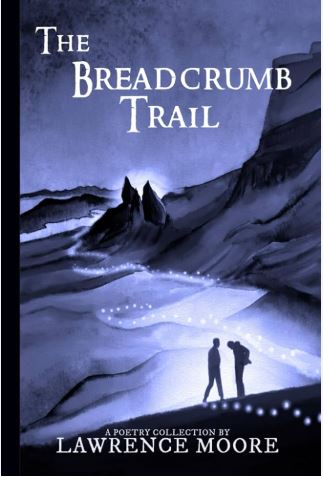
The decision to frame all of the poems within this fairy-tale world has proved to be a creative masterstroke as it helps thread the work together and add to the sense of journey that the reader experiences from start to finish. Indeed, the book’s title itself hints at this (the ‘breadcrumb trail‘ being how Hansel & Gretel found their way home through the forest in the much-loved fairy tale). It also provides an enthralling setting for Lawrence to introduce a number of poignant strands like love, loneliness, and introspection.
In ‘Their Morbid Measurings‘ the author uses the image of a tree stump, freshly felled and bearing two hundred rings, to reflect on the passage of time and the ways in which we measure our own lives. He contemplates the whimsical notion of being cleaved into units, querying what measurements would best capture the essence of his existence. The tree rings symbolize a life divided into moments—some regrettable, some hopeful— as he walks in solitude, meditating on how the past, present, and future can intertwine in a single moment of solitary observation.
“Walking on my lonesome, Sunday morn,
‘Their Morbid Measurings’, from ‘The Breadcrumb Trail’ page 22, by Lawrence Moore
Beyond the average human’s casual reach
I chance upon a tree stump, newly felled
Two hundred circles wide, four seasons each“
The theme of loneliness is continued in ‘Interstellar‘, a poem that also introduces a profound sense of longing, against the juxtaposition of the personal and the cosmic. The stars are a symbol of distant love and connection, becoming the object of the speaker’s yearning, embodying the belief that something—or someone—is just out of reach. There’s a mythic quality to the poem, where the speaker almost believes that the presence of the stars is tied to their own sense of belonging or connection. It speaks to the universal human desire for intimacy and the tension between the finite self and the infinite universe.
“I look up at the stars
‘Interstellar’, from ‘The Breadcrumb Trail’ page 47, by Lawrence Moore
and sense that one of them is yours,
almost prepared to believe the myth
that I could never reach it…“
As well as longing, it becomes clear that the author also finds peace and harmony in solitary thought. For example, in ‘Swirling in Sync‘:
“Sometimes it’s okay to be alone
‘Swirling In Sync’, from ‘The Breadcrumb Trail’ page 56, by Lawrence Moore
when the stars
and the clouds
and the moon
intermingle in just the right way,“
The poem celebrates the harmony that exists in the natural world, offering comfort to the author as he connects with the elements and the rhythm of the universe. The repetition of “swirling in sync” suggests a deep, almost spiritual connection to the natural world, where the author finds a sense of belonging amidst the vastness of the earth and sky.
The reader also gains a sense of the tension between external reality and the author’s own internal world. ‘By Phonelight‘ explores this with imagery such as “aging, twisted oak” contrasted with the glowing “phonelight” that guides his journey. The light becomes a metaphor for the act of reaching out, capturing a sense of yearning for transformation and discovery, as the author wishes for passers-by to mistake him for something ethereal, like a glow-worm, so that he may continue to use words to open windows onto his dreamscape.
“I ask that passers-by
‘By Phonelight’, from ‘The Breadcrumb Trail’ page 43, by Lawrence Moore
mistake me for a glow-worm,
that I am left
to lever words like windows
until they open
onto the land I walk in dreams“
In ‘Fairies Exist‘, Lawrence takes the reader deeper into his magical realm, where he asserts that fairies exist, offering a vision of hope and fantasy in opposition to the cynicism of society. The poem challenges the conventional and celebrates belief in the intangible. Through a series of contrasts—”sunset red skies” that remain out of reach, “loves lost in retreat,” and the idea of fairies and the breeze—the poem suggests that there is wonder in the world beyond what is visible. In its final lines, the author confidently declares, “Fairies exist and I will be yours,” embracing a sense of agency and belief that defies the mundane.
“Other folks’ loves are lost in retreat,
‘Fairies Exist’, from ‘The Breadcrumb Trail’ page 66, by Lawrence Moore
scattered and scarred by first springtime heat,
yearn for the forest, hide from the trees.
Fairies exist and so does the breeze.“

‘The Breadcrumb Trail‘ is a compelling and nuanced collection that captures the full spectrum of human experience. From the reflective melancholy of ‘Their Morbid Measurings‘ to the playfulness of ‘Fairies Exist‘, the author navigates themes of isolation, connection, and the search for meaning. Each poem in the collection presents a unique perspective on the complexities of life, offering both introspective depth and a broader vision of the world. Lawrence Moore’s skillful use of imagery, metaphor, and tone challenges the reader to consider the magic and mystery that lie beyond the surface of the ordinary in a poetic journey that is as thought-provoking as it is emotionally resonant.
By Sam Bartle
(‘The Breadcrumb Trail‘ by Lawrence Moore is available to buy from Amazon.
Get free notifications of new posts from ‘Poet In Verse’ by subscribing below:


 Poet in Verse